What Does a Day in a Montessori Preschool Look Like? An Honest Walk-Through for Irvine Parents
What Does a Day in a Montessori Preschool Actually Look Like? An Honest Walk-Through for Irvine Parents
Most Irvine parents have heard the word "Montessori" a hundred times but have never actually seen what a Montessori day looks like. The result is a lot of assumptions: some accurate, some completely wrong.
This is a real, minute-by-minute walk-through of what happens during a Montessori school day at a small program like Little Explorers Montessori in Irvine. No abstractions, no philosophy fluff, just the actual schedule.
7:30 AM – 8:30 AM | Arrival and Greetings
Children arrive individually, not in a bus-drop cluster. Each child is greeted by name, at eye level. They put away their own belongings: jacket on their hook, lunchbox on the shelf, water bottle in the labeled spot.
This isn't just routine: it's the first practical life work of the day. A three-year-old who unzips her own jacket and hangs it up is building independence, sequence memory, and hand strength.
Teachers spend this window connecting individually with each child. If a parent has something to share about the previous night's sleep, a new food sensitivity, or an upcoming milestone, this is the window when it gets communicated.
8:30 AM – 11:30 AM | The Three-Hour Work Cycle
This is the heart of the Montessori day, and it's the single feature that separates authentic Montessori from schools that just use the label.
For three uninterrupted hours, children choose their own work from the shelves. They work at their own pace, alone or with a friend, on materials the teacher has previously introduced to them.
What does this actually look like?
One child is at a small table with the pink tower, stacking pink cubes in size order
Two children are working on rolling and unrolling a rug, practical life
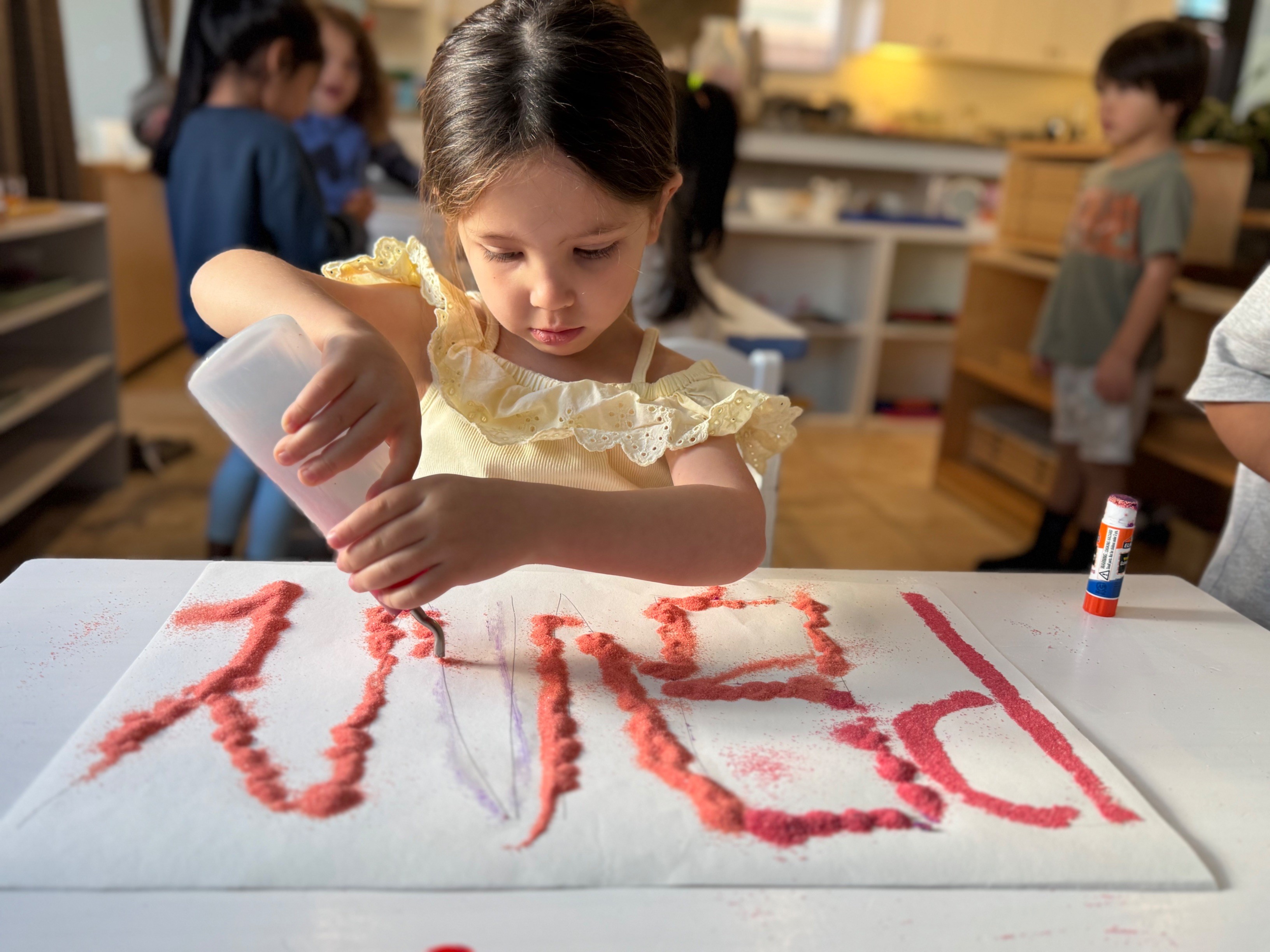
A four-year-old is doing sandpaper letters, tracing each letter with two fingers while saying the sound
A three-year-old is pouring water from a small pitcher into a glass, the whole activity taking ten focused minutes
A five-year-old is at the math shelf with the golden bead material, exploring the concept of the decimal system
An older child is showing a younger child how to fold a napkin
The teacher moves quietly through the room, giving brief individual lessons, observing, occasionally redirecting. There is no group lesson. There is no whole-class activity. Every child is doing something different, and every child is deeply engaged.
The room is remarkably quiet. Not silent, but the kind of hum that happens when children are genuinely absorbed. Maria Montessori called this "the great work of childhood."
11:30 AM – 12:00 PM | Cleanup and Transition
Children put away their materials in the exact spot they came from. This is not staff-cleaned: the children do it themselves. It's another practical life skill, and it teaches respect for the environment.
Hand washing happens in sequence, with real soap, at a child-height sink. Children who are ready set the table with real (not plastic) plates and utensils.
12:00 PM – 12:45 PM | Lunch
At Little Explorers, lunch is homemade every day. Not catered. Not reheated. Actually cooked in our kitchen that morning. A typical menu might be quinoa with roasted vegetables and grilled chicken, followed by fresh fruit.
Children serve themselves from small serving bowls, pour their own water, and clear their own plates. Meals are conversational: children practice manners, language, and social skills while sharing food together.
Food isn't a battle at a real Montessori. Children who serve themselves eat more, waste less, and develop a healthier relationship with meals.
12:45 PM – 3:00 PM | Rest, Nap, and Quiet Work
Children who need to nap, nap. Children who don't, don't. Nap-age children have their own cot or floor bed, prepared quietly by them or the teacher.
Non-napping children move to quiet work: often reading, drawing, or work with quieter materials. There is no forced sleep and no forced quiet, but the environment naturally supports rest.
3:00 PM – 4:30 PM | Outdoor Play and Second Work Cycle
Children go outside. Real outside: not five minutes of "gross motor time" in a linoleum room. Play is largely unstructured, with the natural environment offering its own materials: sand, water, climbing structures, garden beds, real tools.
Depending on the day, this window might include gardening, an art project, music, or a nature walk. At Little Explorers, we often use this window for practical life work with a seasonal angle: planting in spring, harvesting in summer, leaf collecting in fall.
For older children, this is often a second (shorter) work cycle indoors.
4:30 PM – 5:30 PM | Snack and Pickup Window
An afternoon snack: again homemade, again small portions on real plates. Children who are getting picked up put away their work, gather their belongings, and say goodbye.
Parent communication happens here. What did their child do today? Any new milestones? Any concerns?
What You'll Notice Compared to Traditional Preschool
No worksheets. Learning happens with hands-on materials, not paper.
No screens. Ever. Not for teaching, not for downtime.
No group instruction. Every child follows their own path.
No prizes or star charts. The work itself is the reward.
No "arts and crafts hour." Art is available all day if the child chooses it.
Children of different ages working together. A three-year-old and a five-year-old side by side is normal, not exceptional.
Real materials, not plastic toys. Glass cups, wooden bowls, real scissors.
What This Kind of Day Produces
Children who spend their days this way: long, uninterrupted work cycles, self-chosen activities, real responsibilities, mixed-age classrooms: tend to develop specific qualities:
Sustained concentration
Genuine independence
Comfort with academic work (they've been doing it since 3)
Self-directed motivation
Real social skills (learned from working alongside younger and older children)
Respect for materials, environment, and other people
Whether this style of day is right for your child depends on your family's values and priorities. It's not for everyone: and any school claiming Montessori is right for every child isn't being honest with you.
Come See It for Yourself
Reading about a Montessori day is not the same as watching one happen. If you're considering Little Explorers Montessori in Irvine for your child, the best next step is a tour. Watch the classroom during work cycle. Notice the quiet. Notice the concentration. Ask yourself if this is the kind of day you want for your child.
© 2015 – 2025
Little Explorers Montessori
70 Decker, Irvine, California 92620, United States