Early Childhood Program
Early Childhood (3-6 years)
What we 'touch' in our school as fundamentals in Early Childhood education.
Practical Life: Building Independence and Confidence
Practical Life activities support the child’s overall development by strengthening coordination, concentration, and independence. Children practice real-life skills such as pouring, cleaning, food preparation, self-care, and caring for their environment.
In Montessori, the goal is not perfection, but holistic growth. Through purposeful work, children develop self-confidence, self-control, and a sense of responsibility, skills that support learning in every area of life.
Sensorial Learning: The Foundation of Understanding
Dr. Maria Montessori described sensorial work as “the education of the senses.” She believed that children understand the world first through their senses, and that refining these senses is essential to intellectual development.
Montessori sensorial materials are scientifically designed to help children classify, compare, and organize their experiences. Through hands-on exploration, children bring order to what may initially feel like a flood of sensory information.
This work is especially powerful during the Absorbent Mind, when children naturally learn through movement, touch, and repetition. Over time, children develop sharper perception, stronger focus, and the ability to make meaningful distinctions, laying the groundwork for abstract thinking.
Dr. Montessori called this developing capacity the Mathematical Mind: the human ability to recognize patterns, think logically, and move from concrete experience to abstract understanding.
Educating the Senses and Supporting the Whole Child
To educate the senses means to help the child perceive and interpret the world with increasing precision and understanding. Through repeated interaction with thoughtfully prepared materials, children refine their sensory perceptions, moving from broad impressions to increasingly subtle distinctions.
As children repeat activities and receive consistent sensory input, they begin to recognize patterns and relationships. This process supports conceptual understanding and leads the child naturally from concrete experience to abstract thought. By refining their sensory awareness, children deepen their knowledge of the world and strengthen the foundation for future academic learning.
Language Development: Expression, Communication, and Literacy
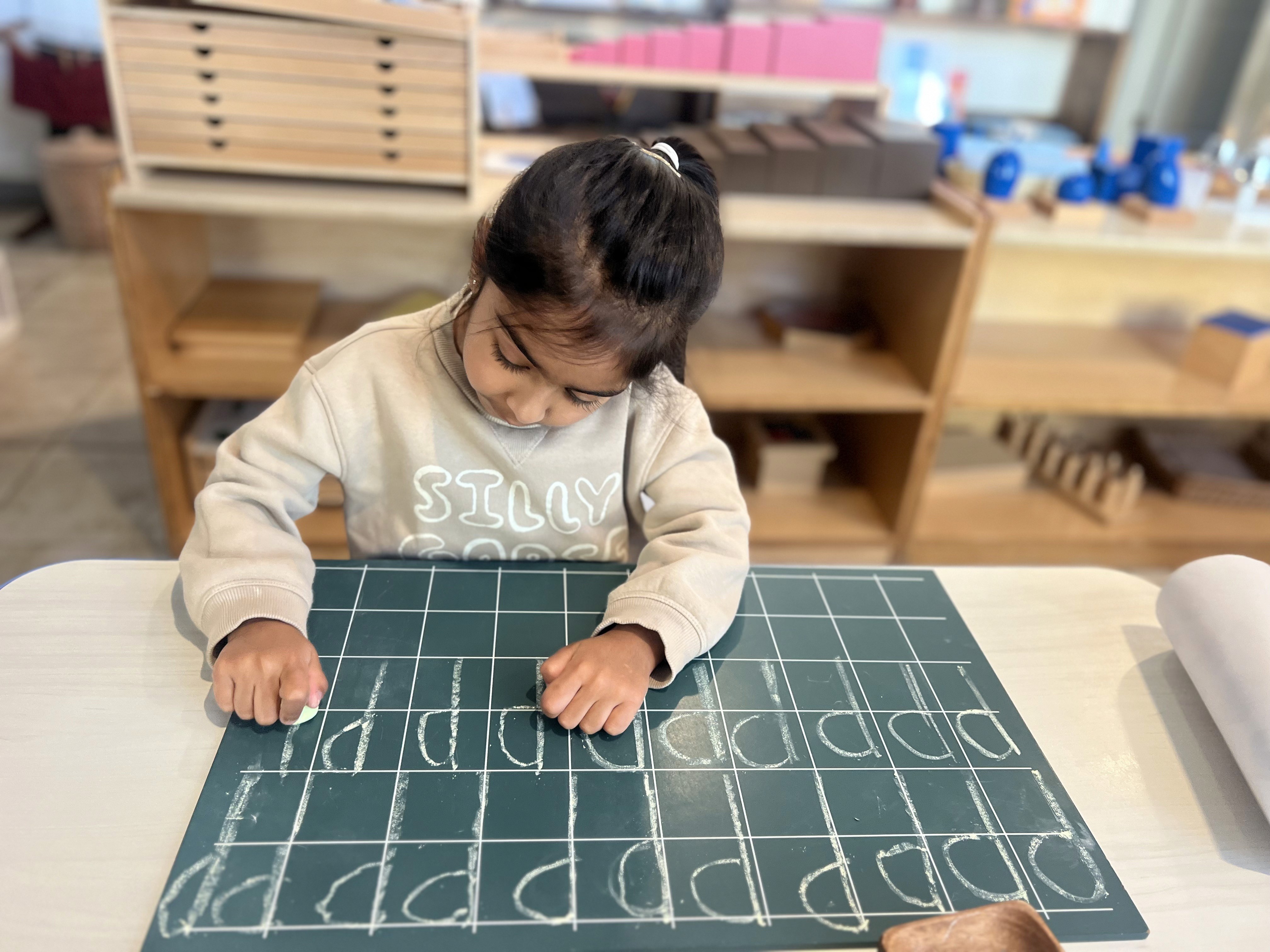
Children are born with a natural drive to communicate. In our Montessori environment, language development is nurtured through rich conversation, storytelling, vocabulary work, reading, and early writing experiences.
Children progress naturally from spoken language to reading and written expression, building confidence in communication and a deep love for language. Learning is meaningful, joyful, and connected to real experiences.
Mathematics: Understanding Before Memorization
Montessori mathematics begins with hands-on, concrete materials that allow children to truly understand quantity, number relationships, and operations.
Dr. Montessori referred to these tools as “materialized abstractions”, materials that make abstract concepts visible and tangible. Children do not simply memorize numbers; they learn to reason, investigate, measure, and problem-solve.
The goal is not early acceleration, but deep understanding and logical thinking, skills that serve children for life.
Physical Development: Movement and Coordination
Movement is an essential part of learning. Through purposeful physical activity, children develop coordination, balance, and control of movement.
Dr. Montessori observed that children with strong bodies often develop strong minds. We intentionally support physical development as a vital part of the child’s overall growth and well-being..
Cultural Studies & Cosmic Education
Science, geography, history, cultural studies, art, music, and peace education are woven together in what Dr. Montessori called Cosmic Education.
Through exploration of the natural world, diverse cultures, and human history, children develop curiosity, empathy, and a deep appreciation for the interconnectedness of life.
A Thoughtful Foundation for Life
Our Early Childhood program is not about rushing children forward, it is about preparing them deeply. In our small, in-home Montessori setting, each child is carefully observed and supported as they grow into confident, capable individuals with a lifelong love of learning.
Take the Next Step
Schedule a Tour of Little Explorers Montessori
Come experience our calm, nurturing environment and see how Montessori learning supports your child’s natural growth. We’d love to welcome your family and answer your questions in person.
© 2015 – 2025
Little Explorers Montessori
70 Decker, Irvine, California 92620, United States